
For brewers and distillers, peeling a lemon is not just a chore; it is a critical “design” process that dictates the final flavor profile of the product.
However, as labor shortages become more severe, consistently peeling massive quantities of lemons at a high-quality standard is extremely difficult. That is why facilities worldwide are now focusing on the “Automation of Peeling” advocated by ASTRA. Using proprietary blade technology, our machines extract only the outer skin with a precision that surpasses manual labor. It makes “Bitterness Profiling”—suppressing unwanted off-flavors—reproducible for anyone.
This article details the revolutionary benefits of automating lemon peeling, complete with implementation case studies and features of each model. Here lies the optimal solution to actualize the craftsman’s dedication while minimizing the burden on the factory floor.

“To extract only the ‘great aroma’ of lemons and yuzu, peeling precision is life or death. Leave it to us!”
In processing lemons and other citrus fruits, the most nerve-wracking step is “peeling.” The difficulty skyrockets when the goal is to harvest the “peel (zest)” rather than the juice. Let’s outline the fundamental challenges of why automation hasn’t traditionally advanced in the field.
Unlike apples or pears, lemons are not perfectly round. They are bumpy, oval-shaped, and vary greatly from piece to piece. When trying to process these with a manual peeler or knife, inconsistencies in applied pressure are inevitable.
Skilled staff can peel them thinly, but peeling hundreds or thousands is a different story. As concentration wanes, peels get thicker, and speed drops. Furthermore, repeating the same motion carries the risk of occupational injuries like tenosynovitis (RSIs).
In real-world settings, manually peeling a single lemon can take dozens of seconds at best, and we often hear that during busy seasons, entire days are spent doing nothing but peeling.
The most detested element in craft beer brewing, gin distilling, and patisseries is the white, spongy layer inside the peel known as the “albedo” (pith).
The albedo contains strong “bitter” and “astringent” compounds. If this mixes into the product, it blocks the refreshing citrus aroma you want to extract, resulting in an off-flavor finish.
“I want to peel only the yellow zest containing the aroma components (essential oils) and leave the white albedo behind.” Adjusting this to fractions of a millimeter by hand is an impossible feat. The dilemma that plagues many processing sites is that the more they pursue quality, the worse their yield becomes, lowering production efficiency.
“Can a machine surpass the quality of manual labor?”
ASTRA’s answer to this common craftsman question is our proprietary “Blade Control Technology.” Let’s explain the functions that not only increase efficiency but accurately express the flavor intended by the creator.
The greatest feature of ASTRA’s automated peeling machines is that the blade tracks perfectly even on irregularly shaped fruit. The machine features a unique mechanism where the blade physically follows the bumps and curves of a lemon’s surface.
Manually, even a veteran takes dozens of seconds per piece; focusing on speed makes it sloppy, while focusing on care takes time—a classic trade-off. However, with an ASTRA machine, the peeling action itself is completed in just about 3 to 5 seconds.
Even including the time to set the lemon, the task is completed in about 10 seconds per unit. Above all, maintaining a constant quality whether it’s first thing in the morning or during the tiring evening hours is the greatest benefit for the factory floor.
The balance of “aroma” and “bitterness” that brewers and distillers obsess over can be adjusted via the machine’s settings.
For example, if you want to minimize off-flavors to the absolute limit, set it to peel only the “zest” ultra-thinly. Conversely, if you deliberately want to add a bitter accent or complex fruity notes, you can adjust the setting to “leave a little white pith.”
“We call this ‘Bitterness Profiling’! You can freely control the peel thickness to match the flavor of the beer you want to brew.”
The ability to not just automate, but allow anyone to replicate “intentional processing” tailored to a product’s concept, is why professionals worldwide choose us.
In the world of craft beer and gin, developing products using “ingredients unique to the region” is a trend to differentiate from competitors. ASTRA peeling machines are not exclusive to lemons. With one machine, you can develop a wide variety of seasonal fruit beers and flavored spirits.
Japan is one of the world’s leading “citrus powerhouses.” Recently, following lemons, inquiries for product development using “Yuzu” have skyrocketed. There are diverse citrus fruits like Amanatsu, Kabosu, and Oranges, all with different sizes and peel thicknesses, but ASTRA machines can handle them all.
Furthermore, it doesn’t stop at citrus. Because it can handle fruits of different shapes like peaches, persimmons, apples, and kiwis, you can develop highly seasonal limited products—like “Autumn Limited Persimmon Ale” or “Spring Peach Weizen”—without any new capital investment.
Beyond peeling just the zest, you can change settings to “peel thickly including the white pith.” This allows the machine to be used as a pre-processor for fruit purees and juice extraction, infinitely expanding your recipe variations.
Citrus procured for processing is generally “B or C grade” with scratches or irregular shapes, unlike those lined up in supermarkets. While they can be purchased cheaply, peeling them beautifully by hand was an extremely back-breaking task.
ASTRA’s technology truly shines when processing these “imperfect fruits.” Because it tracks the surface bumps, even ugly citrus can be reborn into highly aromatic, premium ingredients.
From “Frozen Storage” to “Freshly Peeled”
Another massive advantage of mechanization is the ability to instantly process only the required amount when needed.
This prevents aroma degradation and freezer space constraints, enabling the creation of higher-quality products that leverage the “raw, vibrant aroma of the ingredients.”
“We are a small workshop, so we can’t place a large machine.” “We want to process tons of lemons during harvest season.”
ASTRA offers two main models so you can choose the optimal machine for your production scale and needs.
The tabletop model KA-700H has gained overwhelming support from small to medium-sized breweries, distilleries, and patisseries.
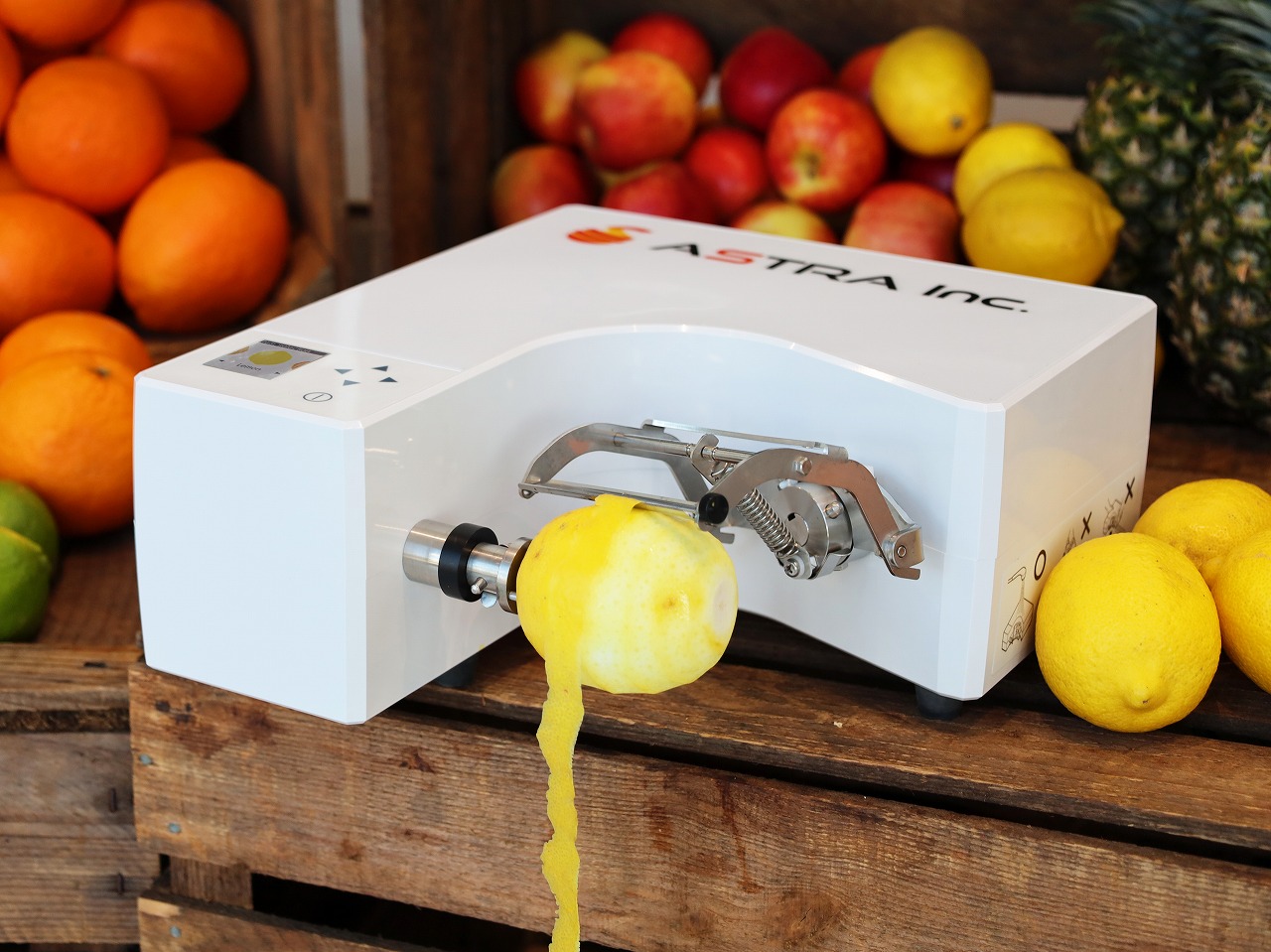
It can be installed in a space about 30cm wide and runs on a standard AC100-240V power supply. Its greatest strength is “Multi-variety adaptability.” Lemons and yuzu, of course, but just by changing attachments, it handles over 20 types of fruits including apples, pears, kiwis, and peaches.
It is the perfect partner for facilities developing small-batch, multi-variety products—like “Lemon day today” and “Peach day for limited beer tomorrow.”
For regional agricultural cooperatives, large beverage factories, and facilities needing to process large volumes of citrus in a short time during harvest, the high-capacity model FAP-1001 is the chosen solution.
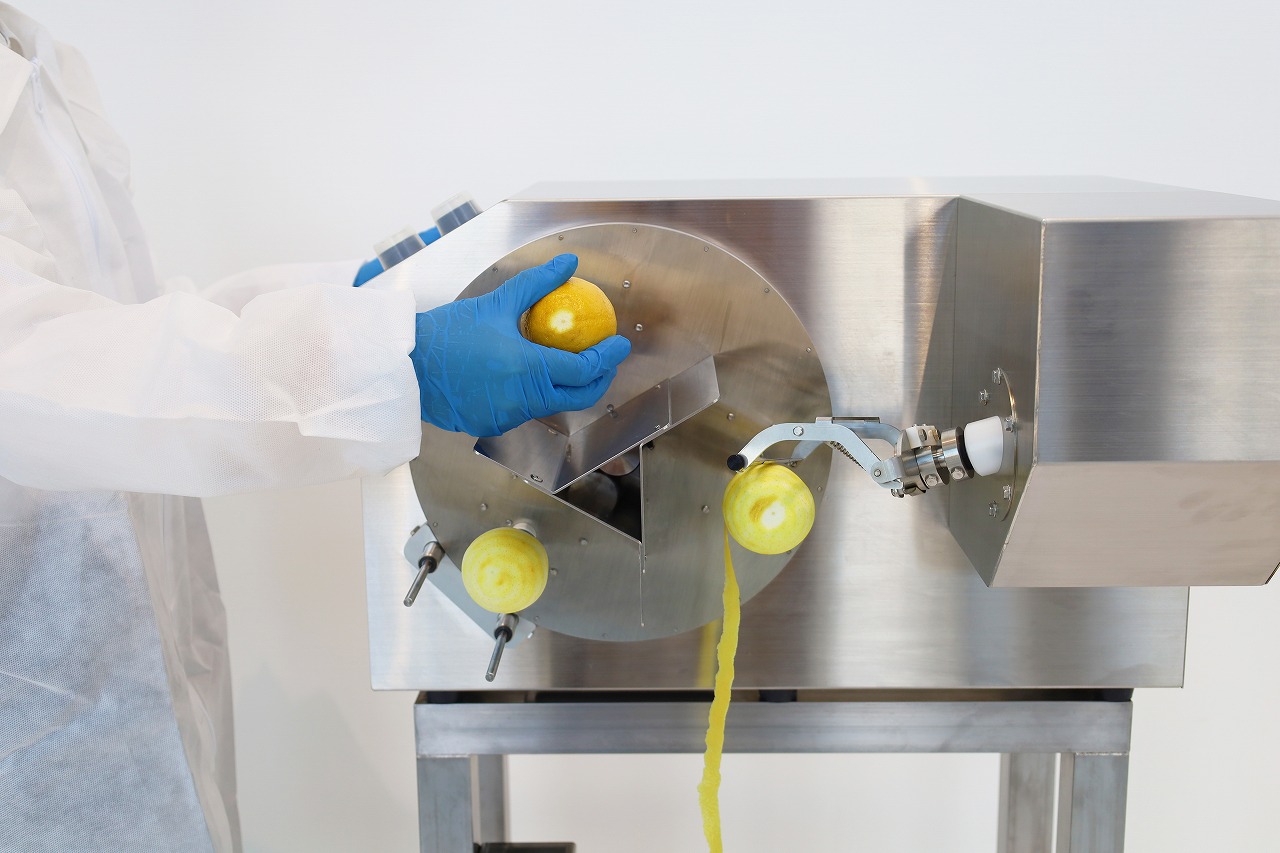
The biggest difference from the KA-700H is the speed and automation level.
Naturally, it still features ASTRA’s proprietary “thin peeling technology” and “irregular shape tracking.” Even in mass production, it maintains a quality (yield rate and beauty) that exceeds manual labor.
Let us introduce a case study of a customer who solved their workplace challenges by implementing an ASTRA peeling machine.
At a certain craft beer brewery, all processing of local lemons was previously done by hand. However, the number of staff was overwhelmingly insufficient for the massive influx of lemons during harvest season.
They occasionally hired temporary staff just for the busy season, but it was difficult to train them to maintain a constant peeling quality (thickness), and health hazards like tenosynovitis from long hours of work were becoming an issue.
“Can it really peel the misshapen lemons we use?” “Can it be adjusted to the exact thinness (zest only) we desire?”
If you have any concerns, please verify them using an ASTRA demo machine.
By sending us your fruits, you can check the peeling process via video and receive the peeled fruits back to inspect the finish. We are utilized by many managers because you can verify “if it really works” with zero risk before implementation.
ASTRA peeling machines are loved by distilleries and breweries worldwide due to their unique peeler structure.
Please reallocate the time and labor previously stolen by the simple task of “peeling” into creative operations like “product development” and “brewing.”
We solve these specific workplace worries with technology. Please feel free to consult with us.
 Before Purchase

After Purchase



 Japanese