
“We want to advance mechanization to solve our chronic labor shortage.”
“We want to strengthen HACCP compliance and hygiene management, but we don’t know which machine to choose.”
For managers at food factories and processing sites, selecting food processing machinery is an extremely important decision that dictates production efficiency and quality. However, the market is flooded with a wide variety of machines, making it difficult to find the “optimal machine for your specific processes.”

“Looking at catalogs, there are so many types it’s easy to get lost. You definitely want to avoid failures like, ‘We bought it, but cleaning it is a nightmare!'”
In this article, ASTRA—a manufacturer of commercial peeling machines that has tackled numerous challenges on the factory floor—systematically explains everything from basic knowledge of food processing machines to the criteria for choosing them without failing.
We have comprehensively covered the types of machines by process, the “Cleanability (Sanitary Design)” you must check before implementation, and even information on available subsidies. Please use this as a guide to solving operational challenges at your facility.
In a food factory, there are many processes from receiving raw materials to shipping the final product. Food processing machinery is essential for streamlining these processes and building a stable production line.
Food processing machinery is a general term for machines that perform physical or chemical treatments—such as washing, cutting, mixing, heating, and packaging—on raw materials like agricultural, marine, and livestock products.
Unlike household cooking appliances, they require durability to withstand long hours of continuous factory operation and capacity (throughput) to rapidly process large volumes of ingredients. Recently, having a structural design that supports strict hygiene management in compliance with HACCP has also become a critical requirement.
The primary motive for considering automation in many facilities is to “solve labor shortages.” With the shrinking workforce, securing skilled manual workers is becoming harder every year.
For example, entrusting simple manual tasks (like peeling and cutting) to machines can bring about the following changes:
Manual work inevitably involves “individual differences” and “inconsistencies due to fatigue.” Machines, on the other hand, can accurately repeat set parameters continuously, contributing greatly to the unification of product quality.
Another crucial factor is the improvement in Yield. For instance, having a machine perform “razor-thin peeling” or “precise weight cutting”—which is difficult even for veterans—minimizes waste loss. In an era where raw material costs continue to rise, this is an important benefit that directly leads to cost reduction.
Related Article: Improve Yield in the Peeling Process! Solve the Limits of Manual Labor with Automation
The types of food processing machines are broadly classified by manufacturing process into four categories: “Prep/Cutting,” “Mixing/Forming,” “Heating/Cooking,” and “Packaging/Inspection.” The main roles and representative machines for each process are as follows:
| Process Category | Main Role | Representative Machines |
|---|---|---|
| 1. Prep/Cutting | Washing, peeling, and cutting ingredients to create the processing base. | Automated peelers, slicers, dicers, vegetable washers |
| 2. Mixing/Forming | Mixing materials together or forming the product’s shape. | Mixers, kneaders, agitators, filling machines, encrusting machines |
| 3. Heating/Cooking | Cooking processes like baking, frying, steaming, or heat sterilization. | Tunnel ovens, continuous fryers, steam kettles |
| 4. Packaging/Inspection | Packing products and checking for foreign objects or defective items. | Vacuum packaging machines, weight checkers, metal detectors, X-ray inspection systems |
This is a critical process that serves as the gateway to the production line. It includes “Automated Peelers” for peeling agricultural products, “Slicers” for cutting to a uniform thickness, and “Dicers” for dicing ingredients.
The precision of this process directly impacts the final product’s appearance and yield (amount of edible portion). Peeling, in particular, is prone to shape variations and ingredient loss when done manually, making it one of the areas where automation yields the most significant quality stabilization and cost-reduction effects.
In the process of mixing multiple ingredients uniformly, “Mixers” and “Kneaders” (for highly viscous doughs) are active. This category also includes “Forming machines (encrusting machines)” that wrap dumpling fillings in dough or shape hamburger patties, and “Filling machines” that pour fixed amounts of liquid or paste into containers.
Because they can rapidly reproduce exact recipes and shapes, they are indispensable equipment for mass production.
This is the process of cooking the ingredients. “Tunnel ovens” and “Continuous fryers,” which continuously heat items moving on a conveyor, dramatically increase the efficiency of high-volume cooking.
Beyond determining taste and texture, this step is extremely important for “sterilization” to prevent food poisoning. Selecting machines that can accurately manage temperature and time is the key to food safety.
In the final packaging process, “Vacuum packaging machines” (to prevent oxidation) and “Pillow packaging machines” (to wrap in film) are used.
Right before shipping, products are passed through “Metal detectors” or “X-ray inspection systems” to check for foreign objects like metal shards or stones. Given the rising awareness of food safety in recent years, the implementation of these inspection devices is proceeding at a mandatory level.
“We decided based on the spec sheet, but it was hard to use on the factory floor.” “Cleaning took so much time that our utilization rate never improved.” These are common failure stories when implementing machinery.
The key to long-term success is to choose based not only on catalog numbers but from the following four perspectives that anticipate daily operations.
The first thing to check is “Processing Capacity (Throughput),” but faster isn’t simply better. Balance with the preceding and succeeding processes is crucial.
For example, even if the cutting process is ultra-fast, if the subsequent packaging process cannot keep up, work-in-progress inventory will pile up, causing a risk of freshness degradation. Additionally, you must simulate the physical size in advance to ensure it can be comfortably installed in the limited factory space without blocking worker pathways.
The most important point of caution in a food factory is “Hygiene Management.” No matter how convenient a machine is, if it takes too much effort to clean and becomes a breeding ground for bacteria, it defeats the purpose.
When selecting, please use the following points as a checklist.
Machines must be considered under the premise that they will “eventually break.” The speed of response during a breakdown directly translates to factory downtime.
Be sure to confirm the manufacturer’s post-purchase backup system, asking questions like, “Are consumable parts readily available?” “Do they have local maintenance hubs?” and “Is phone or online support robust?”
There are “multi-purpose machines” that perform several roles, and “dedicated machines” specialized for specific tasks.
If you are mass-producing a specific product, implementing a dedicated machine tends to yield higher overall productivity. Choose according to your company’s production style.
Implementing food processing machinery is not just an investment in productivity, but an investment in protecting the safety of your workers. Furthermore, there are robust public support systems available to reduce implementation costs. Here, we explain two important points to confirm before signing a contract.
Food machinery dealing with rotating parts or blades poses a risk of severe accidents if used incorrectly. Occupational accident statistics still report “pinching and entanglement” accidents caused by food processing machinery.
During selection, always check if the following safety features are equipped:
Creating an environment where employees can work safely is essential from the perspectives of reducing turnover rates and maintaining corporate compliance.
High-performance machines are by no means a cheap purchase, but utilizing government subsidies can potentially reduce the substantial financial burden. Many food-related companies make capital investments using the following types of systems.
*Application periods and conditions vary by fiscal year. When considering implementation, we recommend consulting early with distributors, chambers of commerce, or consulting tax accountants.
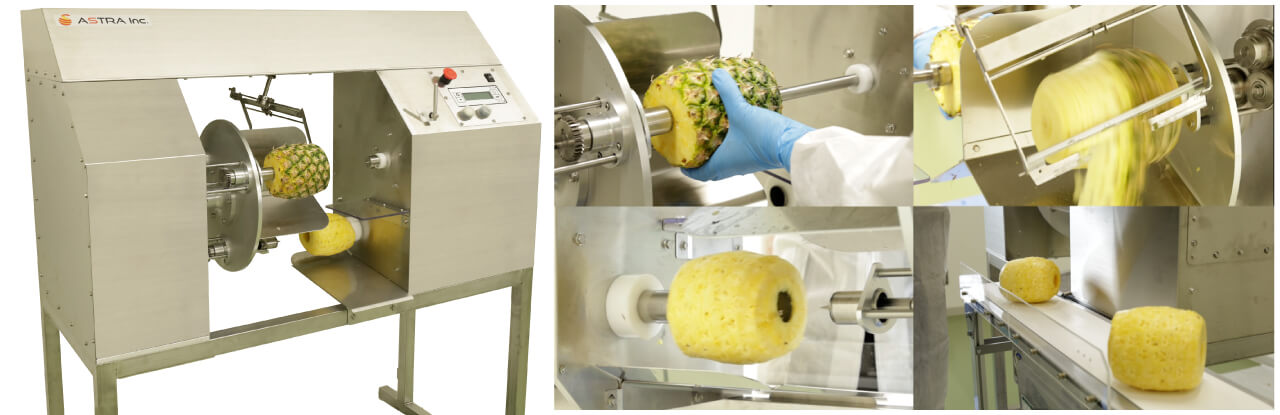
Among food processing tasks, “peeling” is a particularly labor-intensive process requiring high skill. ASTRA has solved challenges in many facilities with our “Electric Peelers,” which combine the beauty of manual work with the speed of machinery.
Traditional peeling work is prone to quality variations depending on the worker’s skill level, and prolonged work carries the risk of occupational injuries like tenosynovitis (RSIs).
ASTRA offers an optimal lineup tailored to the size and characteristics of the ingredients. For large, hard-skinned fruits like pineapples and pumpkins, the KA-750PM series is ideal. Meanwhile, fruits like apples, kiwis, and lemons are handled by the KA-700H and FAP-1001 series, which use proprietary technology to peel thinly and smoothly along the contour of the fruit’s flesh.
“They are even active in facilities that peel up to 10 tons of lemons a season for aroma oil extraction! That’s a volume you could never finish by hand.”
What kind of effect does implementing a machine actually have? Let’s compare using specific numbers.
For example, consider processing 100 kg (approx. 500 units) of 200g fruits per day.
Because the freed-up time can be allocated to other tasks, the actual labor cost reduction effect is immeasurable.
Reducing waste loss (the portion thrown away as peel) is another massive benefit. Let’s look at the example of pineapples, which have thick skins and are notoriously difficult to peel.
| Comparison Item | Manual Peeling (Cylindrical Cutter) | Machine Peeling (ASTRA Product) |
|---|---|---|
| Yield Rate (Percentage of edible portion) |
Approx. 40% | Over 60% |
| Finish | Bumpy, prone to juice loss | Smooth surface, minimal drip |
In this way, a 20% improvement in yield means you can create 20% more product from the exact same raw materials. The machine’s implementation cost can be rapidly recovered through this combination of “Labor Cost Reduction” and “Yield Improvement.”
 Before Purchase

After Purchase




 Japanese