
Are you struggling with the burden of “peeling” and “cutting” tasks in facilities that process large volumes of fruit daily, such as cafes making sweets or supermarkets producing fresh-cut fruits?
Working with manual fruit cutters or knives not only takes up the entire day but often causes severe physical strain on staff, such as tenosynovitis (RSIs).
“If you add staff during peak seasons or ask newcomers to help, they peel too thickly and lower the yield rate… And if the fruits are irregularly shaped, manual cutters don’t work well. It’s really tough!”
Actually, there are various types of commercial fruit processing tools based on “purpose” and “power source.” By selecting the appropriate tool tailored to your facility’s processing volume (e.g., over 100 pieces a day), work time can be dramatically reduced.
This article is a complete guide to the types and characteristics of commercial fruit cutters, from manual cutters to electric peeling machines. From a professional perspective, we will thoroughly explain “how to choose without failing” in order to solve workplace challenges and improve quality and profit margins.
The term “fruit cutter” covers a wide variety of tools, ranging from push-down cutters that slice apples into eighths, to slicers for thin cuts, to dedicated peeling machines.
First, let’s organize the representative tools used in commercial settings by classifying them into 3 categories based on “Purpose.”
| Purpose / Category | Representative Tools | Features / Best For | Estimated Price Range |
|---|---|---|---|
| Cutting / Sectioning | Slicers, Wedgers | Slicing kiwis, cutting apples into 8 uniform pieces. | Tens to hundreds of dollars |
| Peeling | Hand peelers, Electric peeling machines | Removing the outer skin without using a knife. | A few dollars to several thousands of dollars |
| Coring / Special Processing | Corers, Melon ballers | Accurately removing only the center of apples or pineapples. | Tens to hundreds of dollars |
These are tools for slicing fruits into uniform thicknesses or segmenting them into wedges. “Wedgers,” which you push down from above to cut in one motion, are commonly used for apples, tomatoes, and pineapples.
The benefit is that regardless of who cuts it, the size and shape are uniform, ensuring a consistent visual presentation. On the other hand, the downside is that hard fruits require considerable force to push down, and soft fruits tend to be crushed, easily releasing juice (drip).
As an alternative to knife work, peeling tools directly reduce the most burden on the factory floor.
Handheld peelers are cheap and handy, but not suited for mass processing. In commercial settings where dozens or hundreds of fruits are processed daily, hand-cranked peelers or electric peeling machines (automated peelers) powered by motors play an active role. Electric types, in particular, are exceptionally fast and effective at preventing staff tenosynovitis.
Used for the prep work of fruits with hard cores in the center, like apples and pineapples. A representative example is a “corer,” where a cylindrical blade is pushed in to hollow out only the core.
Doing coring work with a knife carries a high risk of injury and often causes edible flesh to be wastefully shaved off (lowering yield). By using a dedicated corer, you can process safely and speedily while maximizing the remaining edible portion.
When considering the implementation of a commercial fruit cutter or peeling machine, the biggest crossroad is whether to choose “Manual (knives or hand-cranked peelers)” or “Electric (automated peeling machines).”
Here, focusing on the particularly burdensome “peeling process,” we will explain the pros and cons of each, and how to choose optimally based on your processing volume.
| Comparison Item | Manual (Knives / Hand-cranked peelers) | Electric (Automated peeling machines) |
|---|---|---|
| Implementation Cost | Extremely low (few to tens of dollars). | Initial investment required. |
| Work Speed | Depends on individual skill. Limits to continuous processing. | Overwhelmingly fast. Processes one fruit in seconds. |
| Finish / Yield Rate | Can peel too thickly or result in distorted shapes. | Blade follows the flesh; thin, uniform, and high yield. |
| Physical Burden | Long hours carry high risk of wrist/arm strain (RSIs). | Just set it and push a button. Burden is almost zero. |
The greatest benefit of manual work or manual peelers is that they don’t require electricity, can be used anywhere, and the implementation cost is extremely low (a few to tens of dollars). If your daily processing volume is only a few to a dozen or so pieces, manual work is perfectly sufficient.
On the other hand, the downsides are “worker burden” and “maintaining quality.” Long hours of work increase the risk of tenosynovitis. Furthermore, caution is needed regarding the pitfalls specific to cheap hand-cranked peelers:
The benefits of electric types are overwhelming speed and a beautiful, uniform finish regardless of who operates it. The surface becomes smooth as if peeled with a knife, and because the flesh is not crushed, dripping is kept to an absolute minimum.
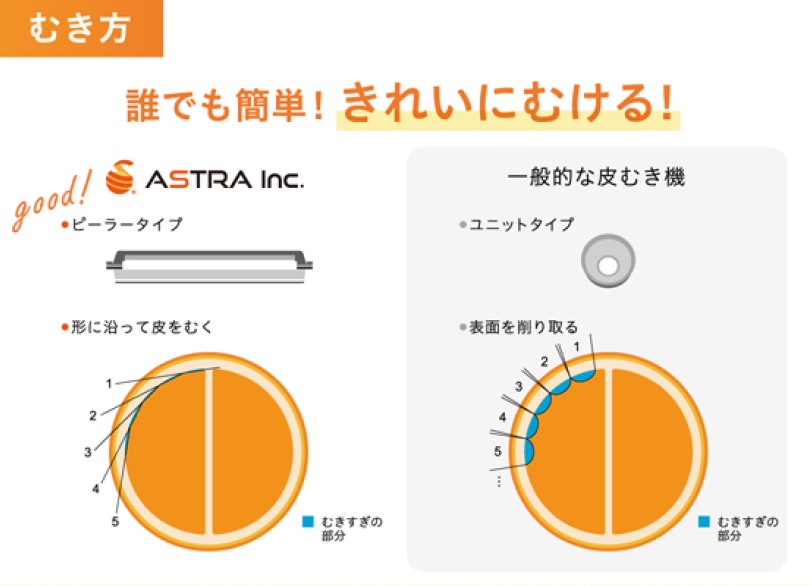
When choosing an electric peeling machine, the “blade structure” is extremely important. Many standard manufacturers adopt a “Unit-type blade (circular),” which scrapes the surface roughly, like a carving tool. Because of this, the surface can become rough, and the cells of the fruit flesh can be damaged.
In contrast, ASTRA’s peeling machines adopt a “Peeler-type” structure. Because the blade enters flatly along the contour of the fruit—just like peeling with a knife—the peeled surface is overwhelmingly smooth. This makes it possible to suppress dripping and maintain freshness longer.
Furthermore, because they peel along the shape of the fruit, they can beautifully peel “irregularly shaped fruits” or “blemished fruits” that are difficult to peel manually, directly leading to food waste reduction (yield improvement).
The downsides are the initial cost required for implementation and the need to secure installation space.
So, specifically, “how many fruits processed per day means we should automate?”
As a general guideline, if you have peeling tasks exceeding “100 pieces” per day, implementing an electric machine will make things dramatically easier, and the cost benefits from reduced labor expenses and improved yield will become apparent.
For example, when peeling 100 lemons, it is not uncommon for manual peeling to consume half a day (about 4 hours). However, by implementing an electric peeler, this is dramatically reduced to a task that takes just about 15 minutes. The several hours freed up can be allocated to other prep work or customer service.
Having understood the pros and cons of manual and electric, what points should you focus on when choosing the commercial fruit cutter that actually fits your store or factory?
Rather than simply looking at “cheap price” or “appearance,” we will explain the “3 Absolute Criteria” from a professional perspective for choosing a tool that will reliably serve you for a long time in the harsh commercial environment.
| Criterion | Check Point | Why is it important? |
|---|---|---|
| 1. Reproducibility (Skill-less) | Will the finish be the same even if a newcomer uses it? | To prevent reliance on individuals and eliminate quality fluctuations. |
| 2. High Yield Rate | Can it leave the flesh without waste? Does it prevent dripping? | To reduce food waste and directly increase profit margins. |
| 3. Cleaning & Hygiene Mgmt | Can parts be easily disassembled and washed? | To prevent food poisoning risks and comply with HACCP. |
The situation to avoid most on a commercial floor is “reliance on individuals,” where “only a specific veteran staff member can peel (cut) it beautifully.”
With knives or manual peelers, the finish changes drastically depending on applied pressure and the angle of the blade. Especially during peak seasons when temps or newcomers perform the task, quality drops instantly. Therefore, the question, “If you just set it and run it, will the quality (thickness/shape) be the same regardless of who uses it?” (Reproducibility / Skill-less) is an extremely vital criterion when choosing a commercial tool.
“Yield rate” refers to the percentage of the original fruit that remains as a usable product (edible portion).
For instance, if a newcomer manually peels too thickly, or forcefully cuts with a push-down cutter causing the flesh to be crushed and releasing massive amounts of juice (drip), the yield rate plummets. This is synonymous with “your profits are being shaved away.”
Therefore, choosing a rotary peeler that peels thinly and uniformly tracking the shape of the fruit (even irregular ones), or a tool that cuts sharply without releasing drip, directly leads to long-term cost reduction and improved profit margins.
In facilities handling food, hygiene management is an absolutely uncompromising point.
Fruit cutters easily accumulate juice and flesh on blades and in crevices. If washing after use is inadequate, bacteria will breed, heightening the risk of food poisoning. Especially now that hygiene management based on HACCP is mandatory, always check the following points:
The “time spent on daily cleaning” is also part of your labor costs. Choosing machines that are easy to maintain guarantees both reduced staff burden and safety.
The optimal way to choose fruit cutters and peeling machines differs depending on the “business type” of the facility and “what you ultimately want to make (purpose).” Here, we explain the challenges in three typical processing purposes and recommend tools to solve them.
| Business Type / Purpose | Points of Emphasis | Commonly Processed Fruits | Recommended Tool Setup |
|---|---|---|---|
| Cafes / Patisseries (Sweets Manufacturing) |
Visual beauty, adaptability to multiple varieties & irregular shapes | Apples, peaches, regional specialty citrus, etc. | Highly versatile electric peeler + small manual cutter for detail work |
| Supermarkets / Factories (Fresh-cut Fruit Mfg.) |
Overwhelming processing speed, freshness retention (drip prevention), yield | Pineapples, apples, kiwis, oranges, etc. | High-speed automated peeling machine & dedicated cutters |
| Breweries / Distilleries (Utilization of “Zest”) |
Technology to peel only the surface skin ultra-thinly (without the bitter white pith) | Yuzu, lemons, oranges, and all citrus | Peeler-type electric machine with thin-peeling settings |
In cafes and patisseries serving sweets, the “visual beauty” of the fruit heavily influences the product’s value. If the flesh is crushed or discolored, it cannot be used as a product.
Particularly popular items like apples for apple pies require massive peeling during daily prep. Also, you likely handle fruits with varying softness and shapes, such as peaches or local specialty citrus, depending on the season.
In this case, the most efficient combination is implementing a “rotary electric peeler” that adapts to fruits of various shapes and softness, and using small manual cutters or knives for the final slicing or decorative cuts. Because the machine peels along the fruit’s contour, even blemished or irregularly shaped fruits finish beautifully, contributing to menu development that leverages regional specialties.
In supermarket backrooms or food factories, manufacturing fresh-cut fruit is a “battle against time and freshness.” How quickly and waste-free you can process high-demand items like cut pineapples, apples, and kiwis directly impacts profits.
When using manual labor or push-down cutters, forced pressure destroys the cells of the flesh, causing juice (drip) to leak in the packaging and accelerating spoilage. Furthermore, “decreased yield” caused by peeling too thickly represents a fatal cost increase for facilities handling mass volumes.
To preserve freshness longer and maintain product value, the implementation of a commercial automated peeling machine that peels as smoothly as a knife without crushing cells, and achieves razor-thin peeling (high yield) regardless of the operator, is absolutely essential.
In recent years, the demand for fruit cutters and peeling machines has surged in business types that use “fruit peel (zest)” as the main ingredient rather than the flesh.
Massive amounts of citrus peels like yuzu, lemons, and oranges are used for condiments like Yuzu Kosho, flavoring for craft beers (fruit ales), and botanicals for craft gin.
Here, the biggest challenge is “how to avoid including the white pith (albedo) inside the peel.” If the white pith gets in, it imparts a harsh “astringent/bitter taste” to the alcohol or condiment.
Continuously peeling only the bumpy surface of hundreds of citrus fruits ultra-thinly by hand is an impossible feat. This is where “Peeler-type” electric machines like ASTRA products shine.
Because the peeling thickness can be finely adjusted and the blade tracks the shape of the fruit, the craftsman-like task of “leaving the bitter white pith behind and peeling only the aroma-packed colored surface skin ultra-thinly” can be automated and done in massive quantities.
In this article, we explained the types and characteristics of commercial fruit cutters, and how to choose between manual and electric models.
If you settle for “we’ll just do it by hand for now” or “let’s use a cheap manual cutter” in fruit processing, long-term labor burdens on staff (like RSIs) and invisible costs (loss of profit) from worsening yields will pile up.
“If you’re peeling over 100 fruits a day, the benefits of mechanization are enormous! There’s no drip, and it looks beautiful, so the customers will be happy too!”
Tailored to your facility’s processing volume and the types of fruits handled (apples, citrus, kiwis, irregular fruits, etc.), reviewing your tools based on the three criteria of “Reproducibility (consistent high quality regardless of user),” “Yield (no waste),” and “Hygiene” is the shortcut to maximizing your floor’s profit margin.
Clarify whether your company’s challenge is “Speed,” “Visual Beauty of the Finish,” or “Solving Labor Shortages,” and by all means, consider implementing the optimal fruit processing tools.
 Before Purchase

After Purchase



 Japanese