
“We don’t have enough staff to finish the prep work,” “I’m worried about injuries from knife work,” “Yield rates vary too much depending on the worker’s skill level”… In food processing facilities, the peeling process is always a major burden. Especially during busy seasons or due to sudden staff vacancies, this process can become a significant risk that halts production.
In this article, we provide a detailed professional explanation of the different types and methods of peeling machines, as well as the specific benefits of labor-saving and yield improvement. We will introduce how to choose a machine that goes beyond simple “automation” to ensure successful post-implementation operation and maximize your facility’s profit margins.
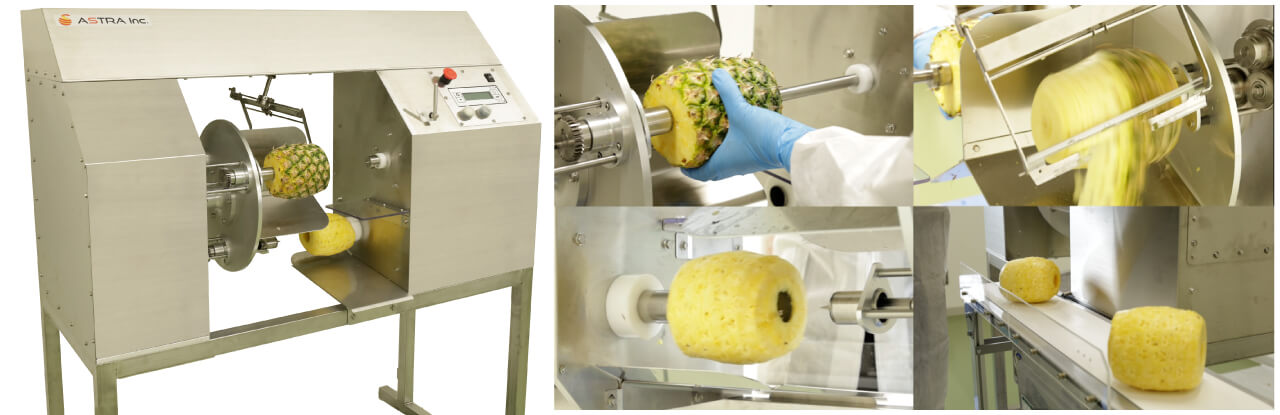
A peeling machine is a device designed to remove the skin of fruits and vegetables at a consistent thickness, streamlining the pre-processing stage. Compared to manual work (using knives or hand-peeling), its main features include the standardization of work (uniform finish), labor savings, and reduction of worker burden. Depending on the challenges of the facility—such as potatoes and onions for school meal centers, fruit processing for supermarket central kitchens, or mass pineapple processing in factories—the “capabilities” and “suitable methods” vary. As a manufacturer, it is important to aim for a state where not only is “time shortened,” but the entire process is improved, including yield rates, hygiene, safety, and training burdens.

“The peeling process often becomes a bottleneck in the facility!”
The basis of a peeling machine is to stably hold the material (ingredients) and remove the skin using blades, abrasives, steam, or heat while rotating or conveying it along a fixed path. While there are various methods, what matters from a facility’s perspective is “how thinly, beautifully, quickly, and stably it can peel” and “how easy it is to clean and manage hygiene.” For example, the blade method makes it easier to process thin skins that follow the shape of the material, resulting in a neat appearance; however, blade wear and adjustment directly affect quality. The abrasive (brush, etc.) method is strong for surface treatment of root vegetables but requires checking the yield rate if there is a risk of over-scraping. The steam method may be suitable for mass processing, but selection must consider the object and process conditions (heat effects, equipment requirements).
“The optimal solution changes depending on whether you prioritize thin skin and appearance or mass processing.”
“Peeling machines” cover a wide range of ingredients. First, common in school meal centers and pre-cut vegetable facilities are root vegetables like potatoes, onions, carrots, and radishes. Next, increasing in supermarket central kitchens and processing plants are fruits like apples, oranges, grapefruits, kiwis, and pineapples. Furthermore, there are specialized machines for ingredients with unique skin properties, such as green onions and garlic. The important thing is to consider the “desired peel thickness (how much edible part to preserve),” “variation in material size,” “individual shape differences,” “peel hardness/fiber/moisture,” and “pre/post-processing (cutting, coring, sterilization, cooling, etc.)” as a set. For example, with ingredients like pineapple where value is concentrated in the edible part, yield rates and finish stability directly impact profit.
Manual work offers high flexibility and low initial costs but is prone to variations in quality, speed, and loss due to skill levels, and incurs training costs. Additionally, knife work carries unavoidable cutting risks, with near-miss incidents tending to increase during busy periods. On the other hand, peeling machines can achieve “reproducibility of quality,” “stability of processing capacity,” and “labor savings” if conditions are met. For example, in a pineapple mass-processing facility, a process that previously required 6 people for hand-peeling was reduced to 2, and the yield rate improved from 45% to 53%, significantly increasing profit margins. This is not just a reduction in labor costs; the improvement in yield changed the perception of raw material costs and pushed up the profitability of the entire process. To achieve such results stably, “operational design”—including material conditions, settings, blade management, and cleaning procedures—is vital. Furthermore, certifications like NSF certification and CE marking serve as important judgment criteria for reliability. Our track record of 30 years of manufacturing, implementation in over 2,000 companies, and sales in over 65 countries worldwide provides peace of mind for facility implementation.
“You can reduce reliance on specific individuals and standardize the finish.”
Peeling machines vary in suitability based on “what, at what finish, and in what quantity” you want to process. Missing this point often leads to implementation failures, such as not being able to peel as thinly as expected, over-scraping, size mismatches, or the machine being abandoned because cleaning is too difficult. Understanding the methods makes it easier to judge whether the machine will actually work in the field, beyond just the numbers in a catalog.
“Choosing the right method is 80% of a successful implementation!”
Automatic peeling machines can keep material holding, rotation (or conveyance), and skin removal at constant conditions, allowing processing to proceed while suppressing variations in finish. This is especially effective in reducing labor costs, improving safety, and lowering training burdens in facilities where hand-peeling is a major load. On the other hand, as the degree of automation increases, the compatibility between material conditions (size range, shape, skin hardness, moisture) and settings becomes more important. To increase post-implementation satisfaction, it is key to check if the design allows for “sustained operation,” including not just processing capacity but also ease of cleaning, replaceability of blades and consumables, safety device operation, and recovery procedures during trouble. From a manufacturer’s perspective, the value lies in a method that achieves both yield and beautiful finishes at high speed.
Peeling machines differ in design philosophy depending on whether they are for “root vegetables,” “fruits,” or “specialized ingredients (green onions, garlic, etc.).” For root vegetables, surface irregularities, soil, and ease of continuous processing are important, and the method selection changes based on the allowable finish range. For fruits, many ingredients have high value in the edible parts, so suppressing over-scraping—yield—is vital. For example, with ingredients like pineapple where raw material unit price and loss have a large impact, uniform finish directly affects profit margins. Specialized ingredients may require custom designs because universal machines cannot handle their unique skin properties, fibers, or shapes. Choosing a model according to the “primary ingredient” of the facility—such as potatoes and onions for meal centers or fruit processing for supermarket kitchens—is the best way to avoid failure.
The benefit of implementing a peeling machine is not just the automation of work, but transforming the pre-processing stage—often a bottleneck—into a “stably running process.” Especially in food processing facilities, busy times often mean a lack of staff, fluctuating finishes, and increased safety risks. A peeling machine aims to reduce facility anxiety and achieve both profit and quality through three axes: labor savings, yield, and safety.
In food processing, yield and quality stability directly impact profit. Hand-peeling is prone to over-scraping (loss of edible parts) and uneven finishes, and quality can fluctuate due to the absence of veterans or busy periods. A peeling machine makes the finish uniform if conditions are met, leading to improved yield rates. As a practical example, in a pineapple mass-processing factory in Hokkaido that introduced ASTRA’s FAP-3000, a process that previously required 6 people was reduced to 2, and the yield rate improved from 45% to 53%, greatly increasing profit margins. This was not just a time-saving measure; by increasing the edible part, the recovery rate of raw material value improved, and the revenue structure was enhanced. The beauty of the appearance is also important; in fruit processing, the “cleanliness of the surface” directly impacts product value, so a method that can peel thinly and uniformly is a strength.
The key to choosing a peeling machine is not to decide solely on the processing capacity in the catalog, but to determine if “operation is feasible” including everyday facility conditions (variation in materials, cleaning frequency, changeovers, worker skill levels). Especially in food processing, where yield and quality directly impact profit, it is best to first set finish standards and then compare in order of processing volume, size compatibility, cleanability, safety, and support systems.
A peeling machine is not equipment where you are done after implementation; the investment effect only appears by “operating it stably.” Immediately after implementation, fluctuations in finish or stops are likely to occur due to variations in material conditions, insufficient setting refinement, or unestablished cleaning procedures. Conversely, by preemptively addressing common troubles and creating a system for daily inspections and consumable management, you can maintain labor-saving effects over the long term while stabilizing yield and quality.
“The secret to long-term use is keeping rules simple!”
 Before Purchase

After Purchase




 Japanese