
“It’s a burden to peel dozens or hundreds of apples every day.” “With a knife, the peel thickness varies depending on the person, and I’m worried about yield loss.” … In restaurants, commissaries, and processing plants, peeling apples is an extremely time-consuming process. Because apples discolor quickly, achieving both “speed” and a “consistent finish” is essential to maintain quality.
In this article, we thoroughly compare the types and benefits of apple peeling machines, from handy home models to commercial ones that support the factory floor. From a professional perspective, we will explain how to choose the best machine for your facility and dramatically improve your operational efficiency.
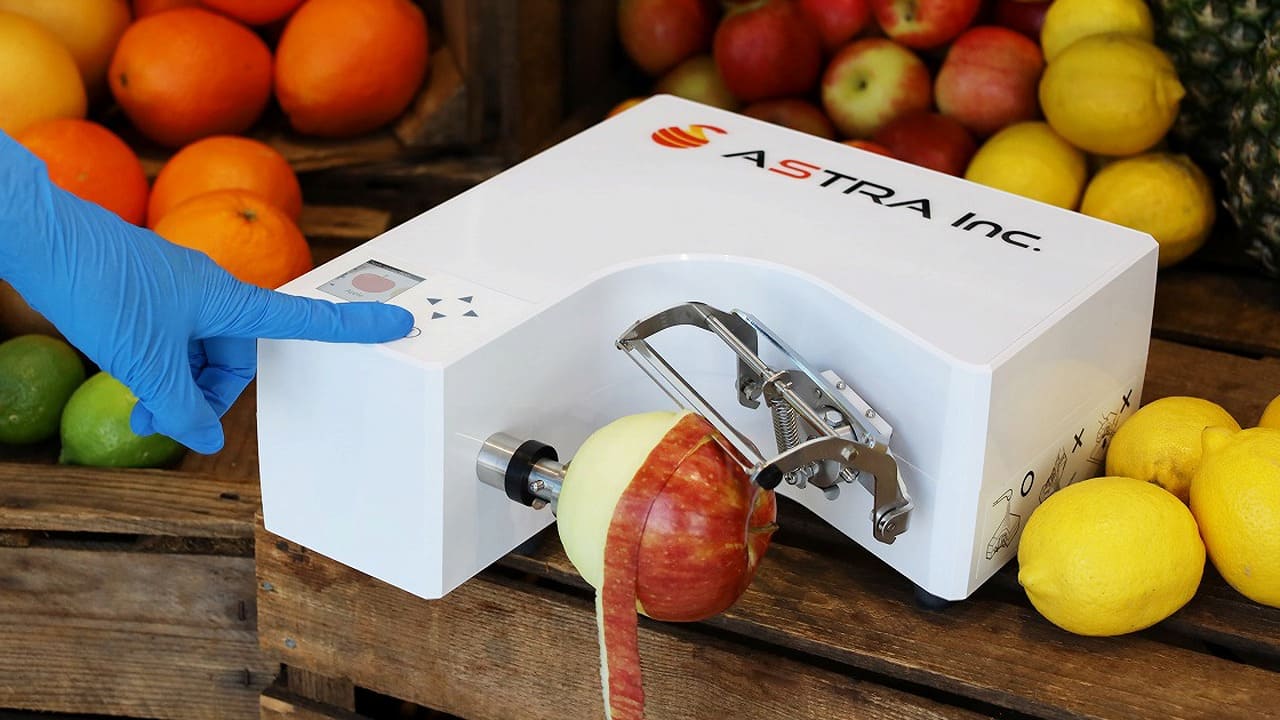
An **apple peeling machine (apple peeler)** is specialized equipment designed to automate the peeling process and stabilize efficiency and quality. Compared to a knife, its greatest benefits are “increased work speed,” “uniform finish,” and “reduced physical burden.” It is widely used for everything from saving time at home to addressing labor shortages in food factories.
The main types are classified into the following three categories based on processing volume and purpose:
The basic criterion for choosing is not just speed, but “stability” suited to your facility’s processing volume and “ease of cleaning.” If it matches your purpose, it directly leads to “time-saving,” “safety,” and a “consistent finish,” becoming a powerful tool to solve workplace challenges.
To get straight to the point, the major difference is that a knife’s quality depends on “human skill,” while an apple peeler unifies quality through its “mechanism.” While a knife is maneuverable and can adapt to peculiar shapes, the speed, peel thickness, and unpeeled patches vary depending on the worker’s experience. On the other hand, an apple peeler standardizes the fixation, rotation, and blade contact, meaning the results are consistent regardless of who operates it. Particularly in facilities that process “a certain volume or more” “every day,” the burden of using a knife accumulates, often leading to fatigue, injury risks, and quality fluctuations. Using an apple peeler simplifies the process and reduces the reliance on individual skills, leading to stable operations even during busy hours.

“Relying on a knife often means relying on a ‘skilled person’!”
The reason an apple peeler saves time is that the work becomes a simple repetition of “Fix -> Rotate (or Feed) -> Peel,” eliminating hesitation. Because it reduces actions like “switching grips,” “adjusting angles,” and “re-peeling” compared to a knife, the overall work time is structurally shorter. Safely, it reduces the time hands are near the blade, which is especially effective in busy workplaces. As a rule of thumb, if you continuously process around 100 apples a day, a knife will likely take 1 to 2 hours, and doing this daily becomes a major stress. A commercial automated type can process the same amount in a short time, making it easier to handle days with staff shortages or sudden production increases. Furthermore, it’s not just about “speed”—stable peel thickness easily uniformizes the yield rate and visual quality, a benefit that cannot be overlooked on the floor.
“When fixation and blade contact become constant, hesitation and do-overs decrease, speeding up the work.”
“It acts as ‘insurance’ for sudden staff shortages or production increases!”
Home apple peelers are suited for purposes where you want to “make small volumes easier,” such as breakfast, snacks, or weekend meal prep. However, cheap products made mostly of plastic can break easily under stress, and because fine adjustment of peeling is difficult, unpeeled patches can increase. Commercial apple peelers excel in facilities that stably process a certain volume, such as commissaries, supermarket backrooms, fruit processing plants, and restaurants. However, because commercial machines have high processing capacity, they can be over-spec for small-volume sites. For example, ASTRA’s KA-700H can peel 400 apples per hour, but a facility processing only about 50 a day might find that capacity excessive. It is realistic to base your decision not only on “current processing volume” but also on “Will it increase during peak seasons?”, “Can it run when staff are absent?”, and “Do we want uniform quality?”. As a common caution for all types, failing to clean the machine or submerging it in water can lead to breakdowns, so it is crucial to choose based on a daily post-use cleaning routine. As a commercial peeling machine manufacturer for 30 years, ASTRA has a track record of deliveries to over 2,000 companies in 65+ countries, and our machines are utilized for fresh-cut fruits at major convenience stores and in-flight meals for major airlines.
“Convenience for small volumes, standardization for fixed volumes is the key!”
Thinking of apple peelers in three main categories—”Handheld Peeler,” “Hand-cranked,” and “Electric/Commercial”—makes choosing easier. In conclusion, the basic mindset is: Handheld peelers for small volumes prioritizing convenience, Hand-cranked apple peelers for medium volumes to simplify tasks, and Electric/Commercial apple peelers for processing a fixed volume or more daily. Importantly, choose a type that fits your operational needs, considering not just speed but also “unpeeled patches,” “peel thickness,” “rotation stability,” and “ease of cleaning.”
“As daily processing volume increases, ‘stable operation’ becomes more important than ‘convenience.'”
“‘How many, and how often’ is the best shortcut!”
The handheld peeler type is the handiest option for those wanting to peel faster and more safely than a knife. Because you hold the apple and move the blade, initial costs are low, storage is easy, and it fits well with breakfast or home prep. However, being manual, the finish thickness is prone to the worker’s habits, and as fatigue builds, unpeeled patches can increase. Also, understanding that cheap material products wear out blades and bodies easily and will likely need replacement long-term reduces the chance of buyer’s remorse. When choosing, prioritize blade sharpness, a slip-resistant grip, and ease of cleaning; if you plan to use it for things other than apples, it’s convenient to check if the shape accommodates vegetables too.
A hand-cranked apple peeler simplifies the peeling process by fixing the apple and turning a handle. Because you can work with a “constant motion” compared to a knife or handheld peeler, speed stabilizes once you get used to it, making it easier to estimate completion time. It is particularly well-suited for batch prep like apple pies or jams, with the advantage that quality hardly wavers even if the operator changes. On the flip side, if the apple is extremely misshapen or the fixation is loose, it can wobble, making blade contact difficult, which often leads to complaints like “it won’t peel” or “it stops midway.” When choosing, prioritizing the fixation method (clamp or suction cup), whether the blade contact is adjustable, and if the base allows stable cranking will prevent failures.
“Since hand-cranked types often suffer from ‘loose fixation = won’t peel,’ check the fixation method first.”
“If the machine wobbles, the peeling wobbles too!”
Electric / commercial apple peelers are the choice for facilities that prioritize processing speed and quality reproducibility. In conclusion, the benefits of electric/commercial machines are most evident if you process a set amount of apples daily, have multiple workers, or want to prepare for staff absences or sudden production increases. While commercial models have highly stable blade contact and mechanisms, making it easy to control peel thickness and minimize unpeeled patches, they can be over-spec for small-volume facilities. For instance, in a site processing only about 50 apples a day, recouping the implementation cost and the effort of setup/cleaning can be difficult. On the other hand, in an operation repeating around 100 apples daily, a process that easily takes 1-2 hours with a knife can be compressed into a short time, paying off in terms of stress and labor costs. Keep in mind that as machines, the basic operation requires “cleaning after use” and “not submerging in water”; neglecting this can cause breakdowns. Confirming “processing volume,” “installation space,” and “whether daily cleaning procedures can be maintained” as a package before implementation will reduce post-purchase regrets.
“The answer isn’t ‘higher specs are better,’ but an apple peeler that matches your ‘processing volume and operations.'”
In conclusion, to avoid failing when choosing an apple peeler, the shortest route is to first determine “Purpose (Processing Volume),” “Fixation (Stability),” and “Operation (Cleaning).” Because there are many types of apple peelers, choosing based on price or looks often leads to regrets like “leaves skin,” “wobbles,” or “don’t use it as much as I thought.” Especially in commercial settings, not just speed but consistent finish and daily maintainable operation dictate the effectiveness of the implementation. Here, we organize the criteria you should check before purchasing by purpose.
“Thinking in the order of Purpose (Volume) -> Fixation (Stability) -> Operation (Cleaning) keeps your choice focused.”
“Before buying, imagine what ‘using it every day’ looks like.”
By purpose, the optimal solution for an apple peeler changes among “Home time-saving,” “Batch prep,” and “Daily mass processing.” For small volumes, convenience wins, but once you exceed a certain number, “stable operation” becomes more important than “convenience.” As a rule of thumb, if you consistently handle around 100 apples a day—a task that easily takes 1-2 hours and becomes a burden with a knife—the benefits of implementing an electric/commercial machine become apparent. On the other hand, commercial machines are prone to being over-spec in small-volume sites due to their high capacity, so it is important to decide the processing volume and frequency first. Especially in facilities that insist on “peeling quality, not just speed” like ASTRA does, the uniformity of the finish is often the reason for implementation, making it ideal for cases where you want consistent quality regardless of the operator.
“In small-volume facilities, prioritizing ‘is it effortless to use?’ over processing capacity yields higher satisfaction.”
If an apple peeler has weak fixation, complaints like “it won’t peel,” “the blade doesn’t make contact,” or “it pops off midway” easily arise, and this tends to be the biggest cause of failure. In conclusion, clamp-types are standard if prioritizing stability, while suction cup-types are for convenience, but suitability changes depending on the workbench’s material and moisture. Regarding materials, cheap home-use products are mostly plastic and can break easily; if you intend to use it long-term, durable metal is a safer bet. For daily use on the factory floor, in addition to strong fixation and material durability, it is crucial to check that it is easy to clean and can be “run daily.”
“‘Loose fixation = won’t peel’ is incredibly common!”
Having replacement blades or a cutter looks convenient, but in conclusion, judging by “frequency of use” and “cleanup burden” prevents failures. Models with replacement blades are easy to restore when sharpness drops and suit those wanting long-term use. On the other hand, while models with cutters can streamline everything from “peeling -> cutting” at once, an increase in parts to wash increases post-use effort, which can eventually lead to the machine gathering dust. For commercial use, adding convenience features often complicates cleaning, so be absolutely sure to confirm if “the structure allows for daily cleaning” before implementation. Since machines can break down if submerged or neglected, prioritizing operational reliability over convenience results in higher long-term satisfaction.
“The more features, the more parts to clean. Choosing based on ‘can I wash this every day?’ prevents regrets.”
“‘Maintainable daily’ is a better answer than ‘looks convenient’!”
In conclusion, commercial peeling machines are an option where implementation benefits become more apparent for facilities that “process a fixed amount or more daily,” “want consistent quality,” or “want to prepare for staff absences or sudden production hikes.” Apple processing volumes tend to fluctuate by season, and in commissaries, supermarket backrooms, and processing plants, situations like “we have a lot today” or “we’re suddenly short-staffed” occur frequently. In such times, a commercial peeling machine serves as a “system” to standardize the work and keep processing running. On the other hand, because their high capacity makes them prone to being over-spec, it is crucial to make decisions encompassing “processing volume,” “quality requirements,” and “operation (cleaning)” prior to implementation. As a commercial peeling machine manufacturer for 30 years, ASTRA has a delivery track record to over 2,000 companies in 65+ countries, and our machines are utilized for fresh-cut fruits at major convenience stores and in-flight meals for major airlines.
“When quality and speed remain consistent even if personnel change, the factory floor keeps running.”
“Commercial machines show their true worth on the busiest days!”
In conclusion, the conditions for choosing an apple peeler for mass processing are the four points of “Processing capacity,” “Finish,” “Setup,” and “Cleaning operation.” Processing capacity is an easy-to-understand metric, but actual factory floor failures include “it’s fast but leaves lots of skin,” “inconsistent quality leads to complaints,” or “cleaning is a hassle so it’s not used.” As a guideline, for operations consistently processing around 100 apples daily, the 1-2 hours of knife work easily become a major stress, making the value of shortening time with a commercial machine apparent. Additionally, the ability to respond to days with staff shortages or sudden spikes in volume (e.g., increased seasonal fruits in school lunches) is a realistic benefit of commercial implementation. Furthermore, in facilities particular about “peeling quality,” the more stable the thickness and uniformity, the easier it is to align yield rate and appearance, resulting in making the entire floor’s job easier.
“If you consistently process around 100 apples daily, the effectiveness of a commercial apple peeler becomes apparent.”
When looking at the specifications of a commercial apple peeler, it is important to imagine not just the numbers on the spec sheet, but “will it cause trouble on the floor?” In conclusion, cautions boil down to three things: “Installation and setup,” “Cleaning,” and “Appropriate processing volume.” For example, ASTRA’s KA-700H can peel 400 apples per hour, but a facility doing only about 50 a day will likely waste its capacity, making ROI difficult. Also, because it’s a machine, submerging it or neglecting cleaning can lead to breakdowns, so a daily post-use cleaning routine is a prerequisite. Deciding “who, when, and how the cleaning procedure will be run” at the spec confirmation stage reduces the risk of it going unused after implementation.
“‘Can you clean it?’ is the dividing line for successful implementation!”
In conclusion, the differences between home and commercial models are that their “Durability,” “Ease of adjustment,” “Reproducibility,” and “Operational prerequisites” are entirely different. While home models are handy and cheap, they are mostly made of materials like plastic and can break easily, cannot make fine peeling adjustments, and may leave more unpeeled skin. Commercial models are designed with daily use in mind, prioritizing a stable rotating structure and quality reproducibility; thus, even if the worker changes, the finish remains uniform, and they hold up well against staff shortages or production increases. However, commercial models require not just the initial cost, but a premise of “daily operation” including cleaning and setup. In other words, judging becomes easier if you think of home models as “tools for occasional ease” and commercial models as “systems to keep the floor running.”
“Home is for convenience, commercial is for durability and reproducibility. Since the purposes differ, the axes for comparison also change.”
“Choose based on ‘occasionally convenient’ vs ‘running it every day’!”
 Before Purchase

After Purchase




 Japanese